Monday, 10 February 2025
Sunday, 9 February 2025
Economic Disillusionment and Housing Crisis

Economic Disillusionment and Housing Crisis
- @Scott-W: "My parents bought their house worth 1.5x the average annual wage. That same house today is worth 50x the average annual wage. But just work harder."
- @griffin1366: "Doesn't matter how hard I work, how many hours I work. Housing isn't affordable. Boomers and their 65 investment properties talking down on us saying to 'just work hard bro.' The irony in that."
- @MozziesArt: "Thirty years ago they would have been absolutely kicking butt and already have houses. Today they are doing just okay and every one of them rent."
- @OUpsychChick: "So many of the opportunities I had are gone now, offshored to other countries, and I can't even imagine trying to buy a first home today."
Commentary:
These comments encapsulate the widening chasm between past and present economic realities. The generational divide is stark: Boomers experienced affordable housing relative to income, while Millennials and Zoomers face hyper-inflated property values, stagnant wages, and an unattainable path to homeownership. The frustration stems from outdated advice—"just work harder"—which ignores structural economic shifts.
2. The Changing Work-Life Balance
- @ApoplecticDialectics: "We're supposed to work to live, not live to work. Someone needs to clean the toilet. I have been doing this for decades and I am tired."
- @XRandomuser1792X: "As much as Gen Z annoys the piss out of me, I get it. I've never resonated with the whole 'work your life away' mentality. Working sucks lol."
- @thetalkinganvil8366: "She doesn't complain about having to work, she complains about the clusterfuck of economy and society."
- @Kmax3000: "It is a big adjustment to go from school to a work life."
- @cmoullasnet: "The actual issue is that most people need dual incomes to survive now."
Commentary:
A fundamental shift has occurred in how work is perceived. Where older generations saw employment as a means to stability and upward mobility, younger generations see it as a trap—long hours with diminishing returns. The rise of dual-income necessity and the erosion of the traditional single-earner household further exacerbate this dissatisfaction. The exhaustion is real, and the generational dissonance only deepens the divide.
3. Generational Responsibility and Cultural Shifts
- @joesisco1925: "We teach our kids how to survive in the 70s and 80s. We need to evolve our teaching to learning survival in the 2020s and 30s. These kids are behaving the way we taught them to behave. We should be flogging ourselves, not them."
- @michaellovullo7363: "Now my generation to the Millennials have basically convinced the children that breaking the people into small groups and trying to fight for everything at the same time is a winning formula. It creates division."
- @jshrrh87: "I'd hate to be entering the workplace today. When I was a young married, we could buy a house on one income, today that's completely unattainable. I feel her pain."
Commentary:
Some older individuals recognize the failures of their own generation in preparing the next for modern realities. There’s a tension between nostalgia for a "simpler time" and acknowledgment that new survival strategies are needed. The critique of fragmentation—dividing struggles into identity-based causes instead of economic unity—is an insightful take on why collective progress feels stalled.
4. The Psychological Toll of Economic Hardship
- @Reaper-ml6ly: "As a millennial, my retirement plan is literally societal collapse."
- @NearlyH3adlessNick: "It just doesn't seem like any of it is even worth it anymore. They can take all the progress away in a second, gaslight your family into hating you, and arbitrarily remove you from public spaces. What's the point?"
- @13StJimmy: "How are people my age and younger ever going to afford a home or even have a life worth living? It’s always met with, 'Oh, I did that when I was your age,' and I always respond, 'Yeah, and coke was a nickel, motherfucker.'"
Commentary:
The psychological strain is evident in these remarks. Hopelessness has replaced ambition, with some even joking (half-seriously) about societal collapse as their only retirement plan. The perception that hard work no longer guarantees stability fosters an existential crisis—why participate in a system that offers no tangible reward? These comments underscore a profound sense of betrayal and disenchantment.
5. The Gender and Social Dynamics of Labor
- @Th1nk1n6: "Men actually had someone to come home to that had a meal cooked for them, when men worked 8 hours—often 10-12. Women cooked over ovens and tended children. Women, tell us again of the equality you seek, and how participating in the economy is better than raising a family at home."
- @cmoullasnet: "I think people were probably, on average, happier in partnerships where one person worked while the other was a homemaker."
Commentary:
These comments reflect a nostalgia for traditional gender roles, though they fail to acknowledge economic pressures that make single-income households largely unfeasible today. The romanticization of past labor divisions ignores that many women were financially dependent and lacked autonomy. The frustration here is less about feminism itself and more about the economic structures that have made dual-income households a necessity rather than a choice.
6. The Hypocrisy of Generational Mockery
- @rigelcox: "People make fun of this girl, then in the same breath glorify songs like 'Rich Men of Richmond.' We should be helping each other, not tearing them down. This is exactly what causes my generation to resent the older generations."
- @EasterRising1fan: "I am glad you are defending her, Lauren. Many of our generation have been set up for failure."
- @zlem007: "Most of us right-wingers claim to be Christian. This girl has legitimate concerns. We should offer sound advice and compassion."
Commentary:
This section highlights the contradiction in attitudes toward economic hardship. Many conservatives lament the struggles of the working class in other contexts but dismiss young people's struggles as laziness. The selective empathy—glorifying blue-collar struggles in music while ridiculing real-life complaints—is an inconsistency that fuels generational resentment.
Final Thoughts
This comment section is a microcosm of the broader intergenerational discourse. The underlying themes are:
- The economic system has fundamentally changed—wages haven't kept pace with costs, making traditional milestones like homeownership nearly impossible.
- Work has become a soul-sucking necessity rather than a means to fulfillment, especially as wages stagnate and dual incomes become mandatory.
- Generational tensions are fueled by outdated advice—Boomers underestimate how different today's economy is, while younger generations see little hope in traditional success pathways.
- The system feels rigged, leading to a psychological crisis where participation seems pointless.
- There is hypocrisy in how hardship is perceived—working-class struggles are glorified in media but mocked when young people express them.
The overall takeaway? These grievances aren't born from laziness but from a deep-seated realization that the social contract has eroded.
Saturday, 8 February 2025
Friday, 7 February 2025
Ring Ring
RING RING

Mason called today. That old contraption—no screen to betray the identity of the caller—rang out, its mechanical clamor slicing through the quiet of the afternoon. How strange it is, in these times, to be tethered to such an archaic device, with no advance notice, no flashing lights to warn of an impending intrusion. Just that harsh, undeniable noise, forcing itself into the sanctity of the moment. No flashing screen to forewarn, no visual prompt to guide me, just a steady, unwavering ring—unrelenting in its simplicity. It’s like a reminder from another age, a relic of the past still demanding attention.
Mason, as usual, had seized the opportunity to call, and I knew, almost instinctively, what was coming. There was no relief today, no blessed respite from his ceaseless chatter. It’s become a kind of ritual now, this regular interruption, a part of my life as persistent as the ticking of a clock. And yet, even as the receiver pressed against my ear, I braced myself for the onslaught of half-truths and wild speculations that would follow.
He began, as he often does, with the fervor of one convinced of his own brilliance. The subject this time, he declared with an air of importance, was espionage. The Chinese, he informed me with an unmistakable tone of certainty, had been caught spying on the Liberals in Canada. His words were thick with the weight of importance, delivered with a cadence that suggested he believed himself in possession of the most valuable of secrets. But what came next was nothing more than a patchwork of fantasies, an amalgamation of half-formed thoughts stitched together with little regard for accuracy or truth.
Mason, in his excitement, offered no specifics, no facts—only the vague outline of a story. He didn't even have the name of the key figure involved, not even the name of Chrystia Freeland, whose leadership campaign, he claimed, had been targeted by foreign interference. The name, the facts, the details—they were all conspicuously absent. Instead, Mason wove a tapestry of misinformation, the strands of which he had pulled from who-knows-where—his own half-formed theories, his distorted interpretation of events. In his mind, these were the truths, the unassailable facts of the matter.
His fantasy was not grounded in any reality I could recognize. It was an illusion he had conjured, a narrative of intrigue and espionage that served no one but his own desire for excitement. The more he spoke, the further I found myself drifting from any semblance of logic or reason. It was as if he had taken a brief, passing notion—perhaps something he'd overheard or read in passing—and dressed it up in the most extravagant, absurd clothing. In his mind, the Chinese were everywhere, pulling the strings, manipulating campaigns and elections, and Mason was the lone crusader, bravely exposing their nefarious deeds.
The details of his tale were so lacking in substance, so thin in their construction, that I could hardly bring myself to engage. It was as though he had heard a whisper—an incomplete fragment of something larger—and had built a story around it, a house of cards constructed from rumors and vague notions. And yet, he spoke with such conviction, with such an unfounded certainty, that it was as if his version of events were the one that had been etched into the annals of history. He had no knowledge of the facts, no grasp of the real situation, but in his fantasy, he had all the answers.
Mason had become, in this instance, a purveyor of falsehoods—though he did not know it. He was so consumed by his own need to be seen as knowledgeable, as possessing insight into matters beyond the ordinary, that he had woven this web of fiction, completely unaware of the vast chasm between his beliefs and the truth. He was, in effect, a pawn—no different than those he claimed to oppose—spreading a narrative of foreign interference without a shred of evidence to support it, only the weight of his own convictions to bolster the flimsy structure of his story.
What was most troubling, however, was not the fact that he had crafted such an elaborate tale, but that he truly believed it. There was no self-awareness in Mason, no realization that he was, in fact, serving as a conduit for something far more dangerous. In his mind, he was the bearer of truth, the one who had seen through the veils of deception. But in reality, he was nothing more than a vessel, a channel for myths and fantasies that bore no relation to the world as it truly was.
I listened, as I always do, with a quiet resignation. There was no point in interrupting him, no point in pointing out the glaring inaccuracies of his narrative. He was beyond reason in these moments, lost in the maze of his own fabrication. And so, I allowed him to speak, to weave his tale, even as I knew it was nothing more than smoke and mirrors—nothing but the desperate grasping of a man who longed for significance, even if that significance was built on the fragile foundation of nothing more than imagination.
When the call finally ended, I was left with that strange feeling of unease—the disquiet that always follows one of Mason’s rambling, fantastical monologues. The device fell silent once more, the receiver resting in its cradle, but the absurdity of his words lingered in the air. I could not help but wonder, as I often do, how many others out there share Mason’s delusions, spreading stories and ideas with no basis in reality, all the while convinced they are revealing truths that no one else can see.
Thursday, 6 February 2025
Amidst the cold northern winds that swept across the land of Canada, there arose a great commotion, a stirring among the people, for beyond the southern border, a man of singular temperament and formidable will—one Donald J. Trump—had once more loomed large over the affairs of the nation. His pronouncements, oftentimes unbidden and yet undeniably potent, had sent ripples through the Dominion, rousing both fervent admiration and resolute opposition, much as a tempest does when it rattles the shutters of an otherwise tranquil town.
It was with a flourish and a voice of thunder that the former President had declared his intent to impose tariffs, those metallic shackles upon trade, a move which sent the statesmen of Canada into a flurry of recalibrations, their electoral calculations now entangled in the knots of nationalism. The Liberals and the Conservatives, each with their own ambitions, found themselves pressed upon by the urgency of the hour, forced to weave new narratives of patriotism, for the people would have it so—Canada, proud and unyielding, would not be made to kneel beneath the yoke of foreign decree.
Indeed, it was a curious turn of fate, for while Trump's influence had so often been decried as a force of division within his own republic, it seemed, paradoxically, to have forged an uncommon unity among those dwelling north of the 49th parallel. The populace, stirred by both indignation and necessity, rallied beneath the maple leaf, their voices rising in defense of sovereignty, their leaders compelled to echo the same, lest they be cast aside as weak in the face of foreign aggression.
And yet, the ripples of Trump’s influence did not cease at the shores of economic policy. No, his shadow extended even into the realm of municipal governance, where in the great city of Toronto, an act of defiance was staged within the chamber of its council. With words of unwavering resolve and a unity seldom witnessed, its members affirmed their dedication to the cause of Canadian independence—not through the bearing of arms, nor the raising of barricades, but through speeches that rang with the weight of history and with a plan, unanimously approved, to stand unbowed.
Thus, as the seasons turned and the discourse of the nation swayed upon the gusts of external pressures, the legacy of Trump’s tenure—though no longer bound to the halls of Washington—continued to shape the politics of a nation that, by all appearances, had found in his provocations a newfound determination to assert its own identity. And so, as the tale of history unfurled, it became clear that even in his absence, the man from Mar-a-Lago had left his mark upon the North, indelible as the tracks left by a storm upon the snow-laden earth.
The Death of Europe, with Douglas Murray
It was with a flourish and a voice of thunder that the former President had declared his intent to impose tariffs, those metallic shackles upon trade, a move which sent the statesmen of Canada into a flurry of recalibrations, their electoral calculations now entangled in the knots of nationalism. The Liberals and the Conservatives, each with their own ambitions, found themselves pressed upon by the urgency of the hour, forced to weave new narratives of patriotism, for the people would have it so—Canada, proud and unyielding, would not be made to kneel beneath the yoke of foreign decree.
Indeed, it was a curious turn of fate, for while Trump's influence had so often been decried as a force of division within his own republic, it seemed, paradoxically, to have forged an uncommon unity among those dwelling north of the 49th parallel. The populace, stirred by both indignation and necessity, rallied beneath the maple leaf, their voices rising in defense of sovereignty, their leaders compelled to echo the same, lest they be cast aside as weak in the face of foreign aggression.
And yet, the ripples of Trump’s influence did not cease at the shores of economic policy. No, his shadow extended even into the realm of municipal governance, where in the great city of Toronto, an act of defiance was staged within the chamber of its council. With words of unwavering resolve and a unity seldom witnessed, its members affirmed their dedication to the cause of Canadian independence—not through the bearing of arms, nor the raising of barricades, but through speeches that rang with the weight of history and with a plan, unanimously approved, to stand unbowed.
Thus, as the seasons turned and the discourse of the nation swayed upon the gusts of external pressures, the legacy of Trump’s tenure—though no longer bound to the halls of Washington—continued to shape the politics of a nation that, by all appearances, had found in his provocations a newfound determination to assert its own identity. And so, as the tale of history unfurled, it became clear that even in his absence, the man from Mar-a-Lago had left his mark upon the North, indelible as the tracks left by a storm upon the snow-laden earth.
Wednesday, 5 February 2025
Manhattan Sinking
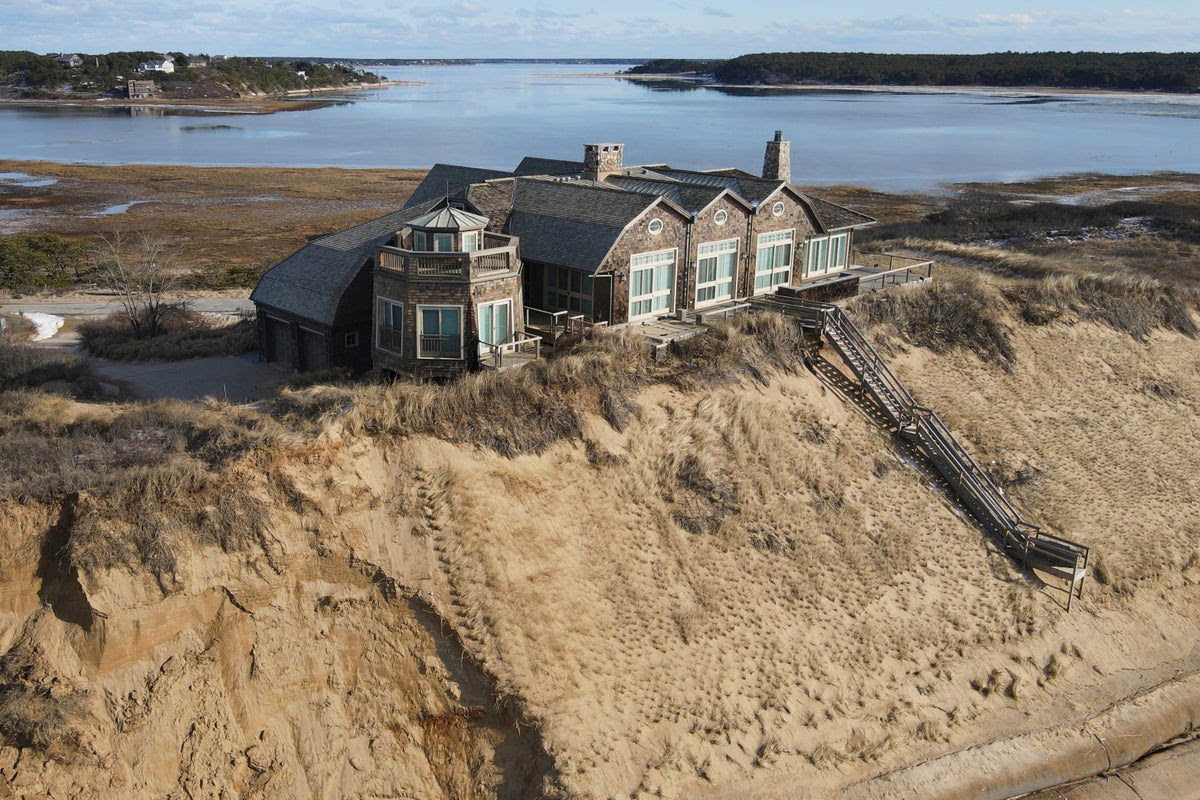 | A multimillion-dollar house overlooking Cape Cod Bay is teetering on the brink of collapse, a stark illustration of the relentless power of coastal erosion exacerbated by climate change. The home ... |
15 years ago, things looked fine. For Trump tower in 15 years there a 3 percent chance of collapse, and in 35 years 50%. Of course, there are fairly easy measures to solve this currently as the Tower is not in such a bad position.
Here’s a projected timeline chart in 5-year increments, estimating total damage and the probability of Trump Tower (or similar high-rises) collapsing if no preventive measures are taken:
| Years from Now | Estimated Total Damage (USD) | Probability of Trump Tower Collapse (%) |
|---|---|---|
| 0 (2025) | $0–10 billion (storm-dependent) | 0% |
| 5 (2030) | $10–20 billion | 0% |
| 10 (2035) | $20–40 billion | 1% (minor foundation weakening) |
| 15 (2040) | $40–60 billion | 3% (flood-related degradation) |
| 20 (2045) | $60–90 billion | 7% (chronic flooding, structural strain) |
| 25 (2050) | $90–150 billion | 15% (storm surge damage, foundation risk) |
| 30 (2055) | $150–250 billion | 30% (severe structural compromise) |
| 35 (2060) | $250–400 billion | 50% (major collapse risk) |
| 40 (2065) | $400–600 billion | 75% (extreme instability) |
| 45 (2070) | $600+ billion | 90% (partial or full collapse likely) |
Assumptions:
- Figures account for cumulative flooding, rising sea levels, and hurricane intensification.
- Trump Tower’s collapse probability rises as foundation damage and environmental stressors accumulate.
Manhattan is confronting an escalating threat from sea-level rise and increased flooding due to climate change. While precise year-by-year projections are challenging due to inherent uncertainties in climate modeling, several authoritative sources provide decadal estimates that illustrate the anticipated progression of sea-level rise in the New York City area.
According to the New York City Panel on Climate Change (NPCC), sea levels are projected to rise as follows:
By the 2030s: An increase of approximately 6 to 9 inches (15 to 23 centimeters), with potential surges up to 13 inches (33 centimeters) in certain areas.
By the 2050s: A rise of about 11 to 21 inches (28 to 53 centimeters).
By the 2080s: An elevation of 18 to 39 inches (46 to 99 centimeters).
By 2100: Sea levels could ascend by 22 to 50 inches (56 to 127 centimeters), with worst-case scenarios projecting increases up to 6 feet (183 centimeters).
These projections underscore the urgency for comprehensive climate adaptation and mitigation strategies to protect Manhattan and its inhabitants from the impending impacts of climate change.
I don't see any common sense failure here. No different than building in New York now. Or Toronto subways. In 2010, things looked fine. In 2018, they tried to correct it. Fifteen years passed.
Trump Tower is in the same boat in 15 to 35 years and no one cares. Toronto has the bluffs. Same crap. Pickering has the green rocks. The same indifference. The water rises, the land erodes, the concrete cracks. People go on like nothing is happening.
Then one day it happens. The water reaches the foundation. The steel rusts, the walls shift. The city knew. They all knew. They watched it happen and told themselves it was fine. Until it wasn’t.
Feb 3rd 2025
A Modest Rebuke to the Astonishingly Misinformed Mr. Mason
It is with the gravest concern for the state of factual discourse that I take up my quill to address the bewildering pronouncement of one Mr. Dave Mason, who, in a dazzling display of Olympian ignorance, has declared that Sir Elton John has never so much as set foot in a domicile beyond the verdant shores of England. One must marvel at the confidence with which Mr. Mason has flung himself into the chasm of public error, as though the abyss itself would catch him and whisper, "Fear not, for truth is what you feel it to be."
Were his assertion no more than the misstep of a common buffoon, a slip of the tongue from an inebriated reveler, or the delusion of a man who believes his dreams to be history, one might let it pass with a chuckle and an affectionate shake of the head. But no, Mr. Mason has proclaimed his folly with the zeal of a medieval inquisitor, armed not with facts but with the cudgel of obstinacy, beating against the gates of reason with all the force of a damp sponge.
Let us, then, conduct a brief and charitable education for Mr. Mason, lest his error be mistaken for wisdom by the unwary. First, we must call forth the evidence—documents, deeds, and declarations—each a damning indictment against his thesis. Lo! In the sunlit grandeur of Mont Boron, in Nice, stands Elton John's French villa, a monument to taste and refinement, defying with its very bricks the absurd notion that he has never possessed a dwelling beyond England’s hedgerows. Perhaps Mr. Mason believes this villa to be a mirage, conjured by Mediterranean heat, but alas! It is listed among the great singer’s residences, an indelible blemish upon the parchment of his fable.
Should we take pity on Mr. Mason and assume he merely overlooked France? We cannot. For then we must escort him to the shores of North America, where upon the vibrant avenues of Atlanta, Georgia, Sir Elton reclines in his penthouse, overlooking a city that would, by Mr. Mason’s reckoning, exist only in the fevered imagination of cartographers. There he has dwelled for years, amidst his vast collection of photographs, each one perhaps whispering to him, "Dave Mason knows not what he speaks."
And let us not forget the stately majesty of Toronto, where Elton John once graced The Bridle Path with his presence, his home a testament to luxury in a country that, if we are to trust Mr. Mason’s narrative, exists solely as a figment of collective delusion. Perhaps he believes Canada to be but a northern extension of Essex, and the people therein to be Englishmen who have tragically lost their way in the snow.
Indeed, if we are to follow Mr. Mason’s logic, one might propose that Elton John is in fact a being of spectral quality, bound forever to the green fields of England, incapable of materializing elsewhere save as an apparition. One might imagine that when he performs in Las Vegas, he must slip between realms, a wraith appearing only under the limelight before dissolving into mist, his corporeal form tethered to some oak-lined estate in Berkshire.
One is left to wonder, then, why the noble Mr. Mason insists upon his preposterous claim. Is it a jest? A test of our collective patience? A declaration of war against the very concept of geography? Or is he, like the flat-earthers of old, simply a man too enchanted with his own fictions to let reality intrude? Whatever the case, we must urge the man, with the utmost compassion, to lay down his sword of error and embrace the warm, illuminating glow of evidence.
For while we may forgive a man for misplacing his spectacles, or even, in times of great distress, for misplacing his trousers, we cannot so easily excuse the misplacement of truth itself.
----------------------------------
Feb 4th 2025
A Stern Admonishment to the Persistently Misinformed Mr. Mason
It is with a heavy heart, and a growing concern for the very fabric of spacetime, that I find myself once again addressing the bewildering pronouncements of one Mr. Dave Mason. He, in a display of stubbornness that rivals the gravitational pull of a neutron star, continues to insist, for the fourth time, that the cinematic masterpiece Star Wars did not grace our screens in 1977, and that the equally legendary Star Wars Christmas Special did not follow in 1978. One might almost admire his dedication to error, were it not so profoundly unsettling.
Mr. Mason’s insistence on this alternate timeline is not a mere slip of the tongue, a momentary lapse in memory, or the harmless delusion of a man who confuses fantasy with reality. No, this is a hill he has chosen to die on, a factual Everest he is determined to conquer, armed with nothing but the flimsy flag of misinformation. He clings to his erroneous chronology with the tenacity of a Jawa scavenging for spare parts, even as the overwhelming evidence screams its correction from the rooftops of cinematic history.
Let us, then, for Mr. Mason’s benefit (and the preservation of our collective sanity), revisit the established facts. Star Wars: Episode IV – A New Hope, the film that launched a thousand lightsabers, premiered in 1977. This is not a matter of opinion, but a documented historical event. It is etched in the annals of film history, enshrined in countless archives, and confirmed by the very fabric of reality. To deny this is akin to denying the existence of the Death Star itself.
And what of the Star Wars Christmas Special? This bizarre, yet undeniably iconic piece of television history, aired in 1978. Its Wookiee carolers and holographic Jefferson Starship performances are a testament to this fact. To suggest otherwise is to rewrite the very tapestry of pop culture.
Perhaps Mr. Mason believes that time is a malleable construct, that the past can be reshaped to fit his own personal narrative. Perhaps he imagines himself as a time-traveling Jedi, altering the course of history with a flick of his wrist. Or perhaps, and this is the most terrifying possibility of all, he exists in a parallel universe where Star Wars didn't come out in 1977. If so, I implore him to stay there.
Mr. Mason, I understand that admitting error can be difficult. Pride can be a powerful force, a dark side tempting us to cling to our mistakes even in the face of overwhelming evidence. But I urge you, for the sake of all that is good and true, to abandon this misguided crusade. Embrace the truth. Accept the reality of 1977. And may the Force be with you.
------
Feb 10th 2025
A Gentle Nudge Towards Epistemological Humility for Mr. Mason
It is with a sense of cautious optimism that I once again address the pronouncements of Mr. Dave Mason. While past encounters have been… let us say, fraught with factual discrepancies, I perceive a glimmer of potential intellectual evolution on the horizon. Perhaps, just perhaps, Mr. Mason is beginning to loosen his grip on the certainty that has so often led him astray.
For too long, Mr. Mason has wielded misinformation like a blunt instrument, citing erroneous "facts" with the unwavering conviction of a seasoned orator. He has clung to these falsehoods with the tenacity of a terrier, even as the tide of evidence has crashed against his pronouncements. His unwavering confidence, while admirable in other contexts, has often served as a shield against the uncomfortable truth: that he might, on occasion, be mistaken.
However, recent interactions suggest a possible shift. A subtle softening of his stance, a hesitant acknowledgment that the universe may not, in fact, revolve around his personal interpretations of reality. Perhaps the repeated corrections, the gentle prodding towards verifiable sources, have begun to erode the foundations of his factual fortress.
It is not my intention to belittle Mr. Mason. We all have blind spots, areas where our understanding is… less than perfect. The crucial difference lies in our willingness to acknowledge those gaps in our knowledge and to embrace the possibility of being wrong. This, I believe, is the path Mr. Mason is tentatively beginning to tread.
The journey towards intellectual humility is not an easy one. It requires a willingness to confront our own fallibility, to admit that we do not possess a monopoly on truth. It demands that we prioritize evidence over opinion, and that we remain open to the possibility that our most cherished beliefs may be flawed.
I remain hopeful that Mr. Mason will continue on this path. That he will learn to temper his pronouncements with a healthy dose of skepticism, and that he will embrace the liberating power of saying, "I don't know," or even, "I was wrong." For in the realm of knowledge, humility is not a weakness, but a strength. It is the key that unlocks the door to true understanding.
Therefore, I offer not a rebuke, but an invitation. An invitation to join the ongoing quest for truth, a journey that requires constant learning, adaptation, and a willingness to let go of our most cherished misconceptions. Mr. Mason, the path is open. Will you join us?
She went viral for trying to give men relationship advice. It doesn't go...
A man named Mark Adler told a story. His friend waited twenty years for the woman of his dreams. She traveled, dated others, lived her life. He worked hard, became successful, and when she was ready, he was there. They married. Three years later, she left, taking a good portion of his wealth with her. Mark had warned him. His friend didn’t listen. Now, they don’t speak.
Another man, Plumbbob Constructionpants, shared his past. He was in the metal scene. Women competed for him. When his band broke up, so did his love life. He saw a pattern. Women didn’t want stable men. They wanted chaos. Drama. The ones who gave them that were the ones who won.
Others chimed in. Some had been married for decades. Some had never married at all. Sinsaiyang asked for prayers—thirty-one years of marriage, now over. Larry Sycamore couldn’t understand why any man still listened to a woman for dating advice. Mountain MGTOW had made his decision—women, he declared, were incapable of monogamy.
They mocked her, the woman in the video. They mocked women in general. They laughed at her opinions, questioned her worth, dismissed her entirely. "Why take advice from a street worker?" Eye776 asked. "She's like the village bicycle," Dennis Aylen added. "Everybody's had a ride." SomeCanine compared her to a broken gasket with a billion-dollar price tag. Jedda73 said no one cared what she thought.
Jean-Louis Lalonde made a joke. “Not tonight, honey, I have a headache. But if Jason Momoa walks in, the headache disappears.”
It wasn’t just about her. It was about all women, all relationships, all the ways men believed they had been wronged. They talked about rules. Epsensei said women made rules for betas and broke them for alphas. Too Smooth warned men to treat a woman like a queen, or she’d treat him like a peasant. Ddiego10 had seen it all before. “The guy she cheats with,” he said, “will never have to make her emotionally safe or do chores. It’s just manipulation.”
In the end, Johngori9477 laid out the options: be an asshole and get laid, or check out, keep your money, and buy what you want.
The internet had spoken..Monday, 3 February 2025
Open Letter To Mason, the Gas Lighter
A Modest Rebuke to the Astonishingly Misinformed Mr. Mason
It is with the gravest (most serious) concern for the state of factual discourse (discussion) that I take up my quill to address the bewildering (confusing) pronouncement (statement) of one Mr. Dave Mason, who, in a dazzling (impressive) display of Olympian ignorance (lack of knowledge), has declared that Sir Elton John has never so much as set foot in a domicile (home) beyond the verdant (green) shores of England. One must marvel (wonder) at the confidence with which Mr. Mason has flung himself into the chasm (deep hole) of public error, as though the abyss (void) itself would catch him and whisper, "Fear not, for truth is what you feel it to be."
Were his assertion (claim) no more than the misstep of a common buffoon (fool), a slip of the tongue from an inebriated (drunk) reveler (partygoer), or the delusion (false belief) of a man who believes his dreams to be history, one might let it pass with a chuckle and an affectionate shake of the head. But no, Mr. Mason has proclaimed his folly (foolishness) with the zeal (passion) of a medieval inquisitor (religious enforcer), armed not with facts but with the cudgel (blunt weapon) of obstinacy (stubbornness), beating against the gates of reason with all the force of a damp sponge.
Let us, then, conduct a brief and charitable education for Mr. Mason, lest his error be mistaken for wisdom by the unwary (unaware). First, we must call forth the evidence—documents, deeds, and declarations—each a damning indictment (accusation) against his thesis (argument). Lo! In the sunlit grandeur (magnificence) of Mont Boron, in Nice, stands Elton John's French villa (large house), a monument to taste and refinement (elegance), defying with its very bricks the absurd (ridiculous) notion that he has never possessed a dwelling (residence) beyond England’s hedgerows (bushy boundaries). Perhaps Mr. Mason believes this villa to be a mirage (illusion), conjured by Mediterranean heat, but alas! It is listed among the great singer’s residences, an indelible (permanent) blemish upon the parchment (paper) of his fable (fictional story).
Should we take pity on Mr. Mason and assume he merely overlooked France? We cannot. For then we must escort him to the shores of North America, where upon the vibrant (lively) avenues of Atlanta, Georgia, Sir Elton reclines (rests) in his penthouse (luxury apartment), overlooking a city that would, by Mr. Mason’s reckoning (calculation), exist only in the fevered (intensely imagined) imagination of cartographers (mapmakers). There he has dwelled (lived) for years, amidst (among) his vast collection of photographs, each one perhaps whispering to him, "Dave Mason knows not what he speaks."
And let us not forget the stately (grand) majesty (splendor) of Toronto, where Elton John once graced The Bridle Path with his presence, his home a testament (proof) to luxury in a country that, if we are to trust Mr. Mason’s narrative (story), exists solely as a figment (illusion) of collective delusion (false belief). Perhaps he believes Canada to be but a northern extension of Essex, and the people therein to be Englishmen who have tragically (unfortunately) lost their way in the snow.
Indeed, if we are to follow Mr. Mason’s logic, one might propose that Elton John is in fact a being of spectral (ghostly) quality, bound forever to the green fields of England, incapable of materializing (appearing) elsewhere save as an apparition (ghostly figure). One might imagine that when he performs in Las Vegas, he must slip between realms (dimensions), a wraith (spirit) appearing only under the limelight before dissolving into mist, his corporeal (physical) form tethered (tied) to some oak-lined estate in Berkshire.
One is left to wonder, then, why the noble Mr. Mason insists upon his preposterous (absurd) claim. Is it a jest (joke)? A test of our collective patience? A declaration of war against the very concept of geography? Or is he, like the flat-earthers of old, simply a man too enchanted (charmed) with his own fictions (false beliefs) to let reality intrude? Whatever the case, we must urge the man, with the utmost compassion, to lay down his sword of error and embrace the warm, illuminating (enlightening) glow of evidence.

For while we may forgive a man for misplacing his spectacles (glasses), or even, in times of great distress, for misplacing his trousers (pants), we cannot so easily excuse the misplacement of truth itself.
My Ground hog Parody
February in the G20: A Tale of Two Hemispheres
It was the best of times, it was the worst of times, it was February, that curious bridge between the grip of winter and the stirrings of spring, between the indolence of summer and the shadows of autumn. Across the great expanse of the world, nations observe this month with their own customs, rituals, and contradictions, a patchwork of festivity and austerity, of warmth and frost, of toil and revelry.
In Argentina and Brazil, Carnival erupts in a frenzy of color, a grand masquerade where for a fleeting moment, the drudgery of daily existence is eclipsed by sequins, music, and the illusion of boundless joy. In the vineyards of Mendoza, the grape harvest begins, a reminder that even as some dance, others labor, bending to the rhythm of nature rather than to the strains of a samba.
Beneath the relentless summer sun, Australia and South Africa hum with the energy of the season. Their citizens bask in beachside leisure, savoring the long days before autumn whispers its first warnings. Yet, even in these lands of sun, history lingers in the air, in the murmurs of the past that echo through streets lined with colonial facades and the unquiet rustling of a world forever shifting beneath the weight of change.
Far to the north, where February wears its chill like an iron cloak, nations endure. Canada, Russia, Germany—each wrapped in its own burden of snow and sky, each moving through a month that tests patience and resilience. In Paris, fashion defies the drear, parading forth in defiant splendor, while in Berlin, cinema flickers, painting stories that momentarily distract from the long, dark nights.
Across the East, the lunar calendar wields its ancient authority. In China and South Korea, families gather, bridges are built between past and future, and the tide of human migration surges in great waves, returning daughters and sons to the hearths of their ancestors. The air hums with celebration, yet beneath it runs the undercurrent of a world that never truly stops, a modern age that both honors tradition and strains against its grip.
And in America, February is a riddle. It commemorates history, it watches a groundhog for prophecy, it pauses for presidents and lovers, all while rushing forward with the feverish determination that is its hallmark. The pageantry is grand, the moments fleeting, and yet, in the endless reinvention of meaning, there lies an unshakable truth—February, like all things, is what we make of it.

Everywhere, February is both yoke and liberation, a month that drifts between purpose and pretense. But even in its contradictions, in its great unfolding story, there is a constant: humanity, ever striving, ever dreaming, ever caught between the past and the promise of what is yet to come.
February in the G20: A Meditation on the Global Spectacle
.png)
February, that most arbitrary of months, serves as a mirror for the contradictions of modern civilization. In one hemisphere, it is a month of icy stasis; in another, it brims with the heat of revelry and excess. Across the globe, nations oscillate between solemnity and spectacle, tradition and modernity, inertia and frenzied activity. The observances of February, though clothed in the language of culture, economics, and politics, ultimately expose the ways in which societies manipulate time to impose a comforting illusion of order upon an otherwise indifferent universe.
In Argentina and Brazil, February is a time of bacchanalian release. The Carnivals of Rio and Gualeguaychú present the grand illusion of joyous abandon, where the masses are momentarily liberated from the yoke of labor and responsibility. The music, the costumes, the dancing—all of it serves as a carefully orchestrated escape valve, a ritual of controlled chaos that ensures stability through indulgence. In the vineyards of Mendoza, the harvest begins, reminding us that even in celebration, there is toil.
In Australia and South Africa, summer lingers. These nations, forged in the image of distant empires, bask in the sun even as their ancestral counterparts shiver beneath gray winter skies. The beaches and sporting events offer a transient reprieve from the burdens of history, yet the land itself bears silent witness to past displacements and ongoing inequalities. The cycle of seasons is immutable, but the social fabric is perpetually fragile.
Meanwhile, in the great northern strongholds—Canada, Russia, and much of Europe—February is a month of endurance. The Berlin Film Festival, Paris Fashion Week, and winter carnivals dot the landscape, but they are mere distractions from the monochrome bleakness of snow-laden streets and bitter winds. These nations, built on the mythology of survival, embrace the cold as both a test of fortitude and a source of identity. The citizenry, resigned to their frostbitten existence, press forward, comforted by the knowledge that spring, however distant, remains an inevitability.
In China and South Korea, the rhythms of the lunar calendar dictate the month’s significance. The Spring Festival, a time of renewal and reunion, serves as a reminder of the Confucian order that still underpins these societies. Mass migrations occur as millions journey home, a pilgrimage that underscores both the enduring strength of family bonds and the immense economic forces that shape modern life. The spectacle is grand, yet beneath it lurks an unspoken tension: progress demands movement, yet tradition demands return.
In the United States, February serves as a confluence of contradictions. Black History Month seeks to commemorate a past that is still unresolved, Presidents' Day extols figures both venerated and vilified, and Groundhog Day offers a farcical reflection of human attempts to impose meaning upon randomness. The nation, ever preoccupied with its own image, cycles through these narratives with the practiced ease of a marketer selling nostalgia.
Everywhere, February is a construct, an artificial imposition upon the passage of time, yet each nation infuses it with its own peculiar blend of meaning. Whether through celebration or solemnity, festivity or fatigue, humanity persists in its most enduring illusion: that within the unrelenting march of days, there is significance to be found. And perhaps, in that belief, there is something more than illusion after all.